Initiation into Kṛṣṇa Consciousness… What Is It?
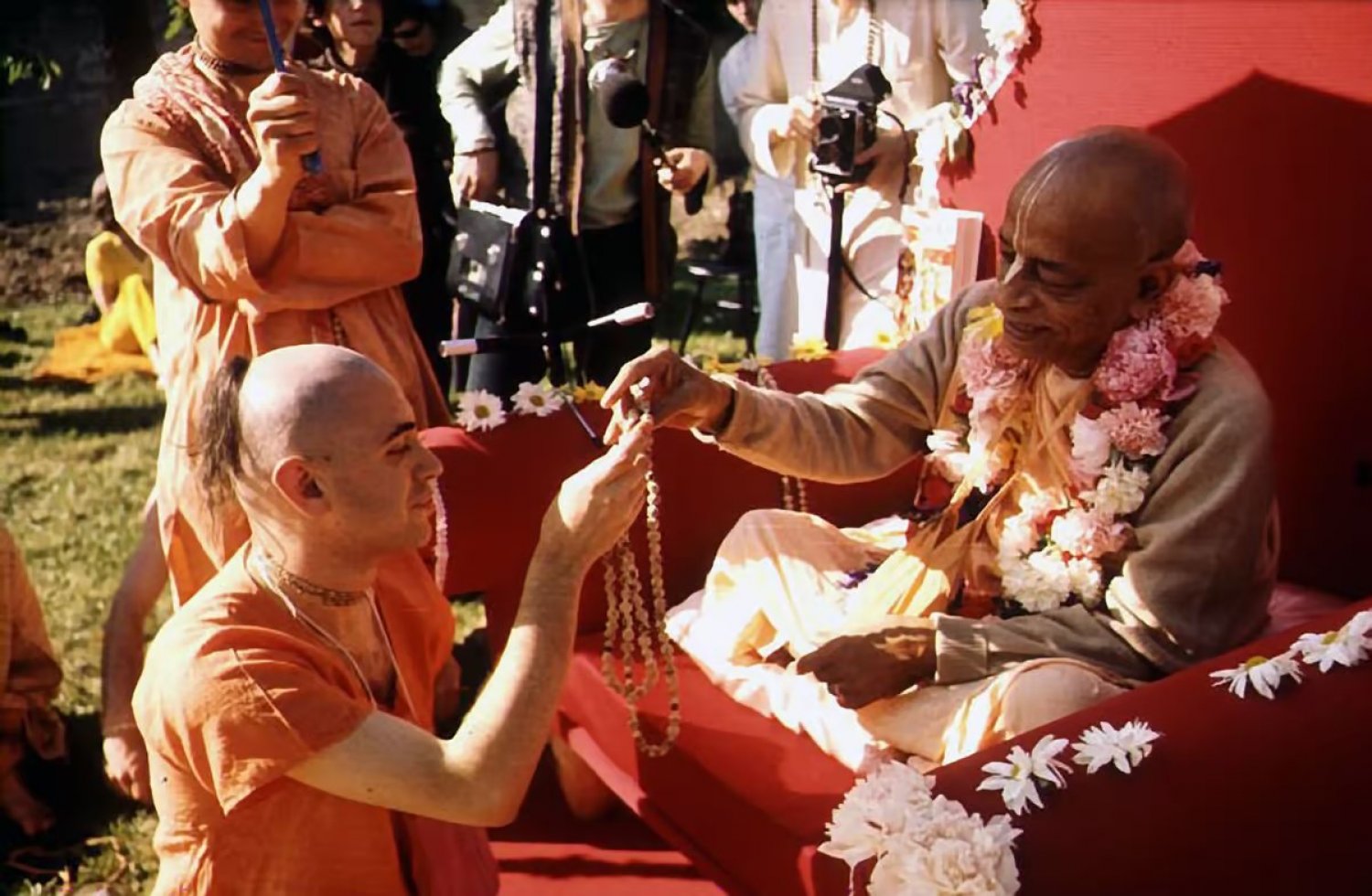
The following essay is a mere collection of thoughts based on the author’s search for reality.
Joining Śrīla Prabhupāda’s movement in 1972 was simple. There was one guru, one mission, and one movement created from inexperienced, immature youngsters who, before entering the shopfront Śrīla Prabhupāda preached from, didn’t know anything about spiritual life beyond what was given to them by “Swamiji”. And Śrīla Prabhupāda, the empowered Founder-Ācārya of the International Society for Kṛṣṇa Consciousness, commanding and not demanding any authority, proved that such a spiritual master can make the blind man see stars in the sky, can cause a lame man to dance, and can make a man who never spoke lecture on the most authoritative and powerful philosophy.
Was he the only one who could do such “wonders”? Yes, he was. But contrary to the offensive dogma of the ṛtvik movement, Kṛṣṇa—God—cannot be limited in His ways to empower an individual messenger to spread His mission. God cannot be limited by some frustrated ṛtvik guru who is nothing more than an imitation of the very same guru he criticises.
When Śrīla Prabhupāda “blew the bomb” for the first time and openly declared that in order to make spiritual advancement a guru or spiritual guide is absolutely necessary, the question from the totally ignorant hippies was, “Where do we find such a guru?” Śrīla Prabhupāda instantly cried while saying, “My guru saved me.”
That finally inspired some hippies to ask Śrīla Prabhupāda, “Are you our guru?” Śrīla Prabhupāda answered, “If you think so.”
He wanted us to understand. He didn’t want us to follow blindly. To accept Śrīla Prabhupāda as the spiritual master was easy. Already before this exchange took place, there were those who were firmly determined to change their lives and follow Śrīla Prabhupāda. Why? Because he entered their heart. It wasn’t the brain as the first instance that made them embrace Kṛṣṇa Consciousness—it was the heart.
In a similar way, Śrīla Prabhupāda explains how he accepted Bhaktisiddhānta Mahārāja as his guru. It was instant, and it was at the first meeting he had with his guru, where Śrīla Prabhupāda describes that he accepted him in his heart immediately. Śrīla Prabhupāda describes that he knew the mission of Lord Caitanya was in the right hands. In our case we can honestly say: when meeting Śrīla Prabhupāda, we knew nothing about some mission or Lord Caitanya Himself. But we knew that Śrīla Prabhupāda entered our hearts. How that happened is difficult to rationalise—the heart is faster than the brain.
As sentimental as it may sound to some, this is the basic principle of initiation.
The final initiation (initiation means beginning, not the end!) is a mere formality.
As Śrīla Prabhupāda writes in a letter…
What is real initiation?
Srila Prabhupada: "Initiation is a formality. First of all, you have to decide whether you will abide by the rules and regulations and become Krsna conscious. That is your consideration. You have to decide for yourself whether you are going to take this Krsna consciousness seriously. That is your decision. Initiation is a formality. If you are serious, that is real initiation. If you have understood this Krsna philosophy and if you have decided that you will take Krsna consciousness seriously and preach the philosophy to others, that is your initiation. My touch is simply a formality. It is your determination. That is initiation."
Back to Godhead Magazine… "The Search for the Divine". From a conversation with His Divine Grace A.C. Bhaktivedanta Swami Srila Prabhupada on July 5, 1972, in New York
The days of thunder—the days of zonal ācāryas—based on an imported idea that a guru is the “owner” of a particular zone and the owner of his disciples, days when Kṛṣṇa Consciousness was still expanding and not imploding as is the case today, finally had to end as the basic concept of being a guru and being a disciple was wrong. Initiation took place on the basis of social pressure and the śūdra-type desire to be part of the majority, the big flock of sheep where, surrounded by other sheep, security can be found.
The heart of the conditioned soul, when contacted by the first preacher, usually gravitates toward that very same preacher, as he is the one who impregnates us with Kṛṣṇa Consciousness. In the history of ISKCON, the preaching pioneers were often replaced by the non-preaching initiators, making the process of initiation something impersonal and mechanical. It should be only logical that such a personal preacher should become our śikṣā and, if desired, dīkṣā guru. But the system until today is different. In the “fragmented zonal ācārya” movement the number of gurus and zones increased, but the zonal spirit of ownership remained. Śūdra-type disciples still seek shelter in the mass of other sheep-like disciples, with very little brain involved in understanding the very basic principle of initiation: the uncompromised nature of the guru and his determination to follow the Founder-Ācārya, complemented with the absolute determination and sincerity of the disciple to go back home, back to Godhead.
Initiation in many regards became a farce, a social “thing to do” in order to enhance our pseudo-spiritual social image. What is the proof for this daring statement?
So many disciples don’t even follow the instructions of their guru—either because there are none, or they simply don’t care. So many come and disappear again. The word 'disciple' is derived from 'discipline', but that’s often ignored. There are disciples who accepted their guru in firm belief that he would connect them to the Founder-Ācārya, Śrīla Prabhupāda, and when discovering that he is not doing so, they patiently and mercifully follow their guru externally while suffering doubts whether he is “the only one”.
Yes, often disciples are better followers than their gurus.
That’s a fact.
But Guru is not “the only one”. Śrīla Prabhupāda described a guru as being part of the guru-paramparā, disciplic succession, and thus being a messenger—a postman who delivers what was given to him. A postman does not open the mail, he does not change it, and he does not try to imitate the original writer of the mail—he simply delivers it. Of course, a guru is a person, an individual devotee. There are today different gurus, and as long as they don’t change or deviate from the original mission entrusted to them, they are authorised.
When a truly surrendered disciple meets a truly guru-paramparā–chaste guru, amazing things can happen, and both become invigorated and empowered to a higher degree. After all, they derive the same energy from the same source—the lotus feet of the Founder-Ācārya. It can even happen that the chaste disciple is occasionally so empowered that even his guru is amazed and inspired by him. Śrīla Prabhupāda was truly amazed at how many books we could distribute for him.
As Bhakti Charu Swami once wrote to me regarding re-initiation—a sad occasion resulting from regularly falling-down gurus in ISKCON:
Spiritual life is completely voluntary. There should not be any hard and fast rules in these relationships as such. One must follow the heart while taking precaution not to be dominated by sentiment or the senses. That is why it is necessary to also take guidance from scriptures and higher spiritual authorities.
We must take note that in our line, many of our acaryas, although initiated by very exalted Vaisnavas, even associates of Sri Caitanya Mahaprabhu, have their main link to the parampara through a siksa relationship. For example,
Narottama dasa Thakura was initiated by Lokanatha Goswami, an associate of Sri Caitanya Mahaprabhu, but his link is actually through Krsnadasa Kaviraja Goswami. What to speak of obvious mistakes like forcing the devotees to take reinitiation without giving them the option to choose their new diksa guru.
Further, they are not given the necessary time to properly develop the relationship. If someone finds a genuine, heartfelt bond with another Vaisnava, he obviously has the right to cultivate that relationship.Thank you once again for all your care and concern for Srila Prabhupada’s family.
I hope this meets you well.
Your servant,
Bhakti Charu Swami
Why, prior to his sudden death, Bhakti Charu Swami changed his attitude and declared himself blindly loyal to ISKCON as an institution, regardless of its deviated status, is a mystery to me. He died soon after doing so.
Śrīla Prabhupāda desired to open our eyes, not to close them. He was inspired by us standing on our own feet in total dependence on him—not hanging on his feet as dull, brainless shackles. Such blindfolded disciples burden the guru. An inspired, self-standing disciple, fully engaged in the mission of the guru-paramparā according to his varṇa, āśrama, and eagerness to serve to the maximum of his ability, is inspiring to his guru and fills his heart with joy.
Surrendering fully is individually a challenge for any sincere devotee. Soon after I joined Śrīla Prabhupāda’s movement, one devotee told me, “Kṛṣṇa is not so interested to see what you are giving. After all, what can you give from His property? But He is interested to see what you are hiding from Him.”
I never forgot this statement and took it as a challenge to look into my heart daily and ask myself the same question: What more am I hiding?
When an authorised disciple meets an authorised guru, all this will be revealed.
When a pseudo-disciple meets a pseudo-guru, hypocrisy prevails, and Kṛṣṇa Consciousness becomes a sort of theatrical performance, entertaining fools. When the curtain in such a theatre finally falls and the performance is over, everybody returns to their posts, designated uncompromisingly by the law of karma.
Real initiation brings real results. Both the guru and the disciple become invigorated and increasingly enthused to serve the mission of the Founder-Ācārya—Kṛṣṇa’s mission to spread Kṛṣṇa Consciousness around the world, or at least in their domestic area. If this basic principle is not understood, a movement ceases to be a movement—as it doesn’t move anywhere—and both the disciple and the guru become imploding introverts, filled with fear while being on constant “retreat”. There is no unity in such a “movement”, as everybody is concerned only with himself.
But those who truly follow Śrīla Prabhupāda’s example—the one who sacrificed himself entirely for our benefit, the one who showed us the true meaning of the word ‘love’—such real devotees continue seeking new inspiration to become more Kṛṣṇa conscious from a real guru with the same sort of unmotivated, unselfish enthusiasm. Initiation then becomes a natural and invigorating act. The guru resides in the heart of the disciple, and the disciple resides in his heart.
This is initiation.