Is It Offensive to Glorify Book Distribution Sankirtan?
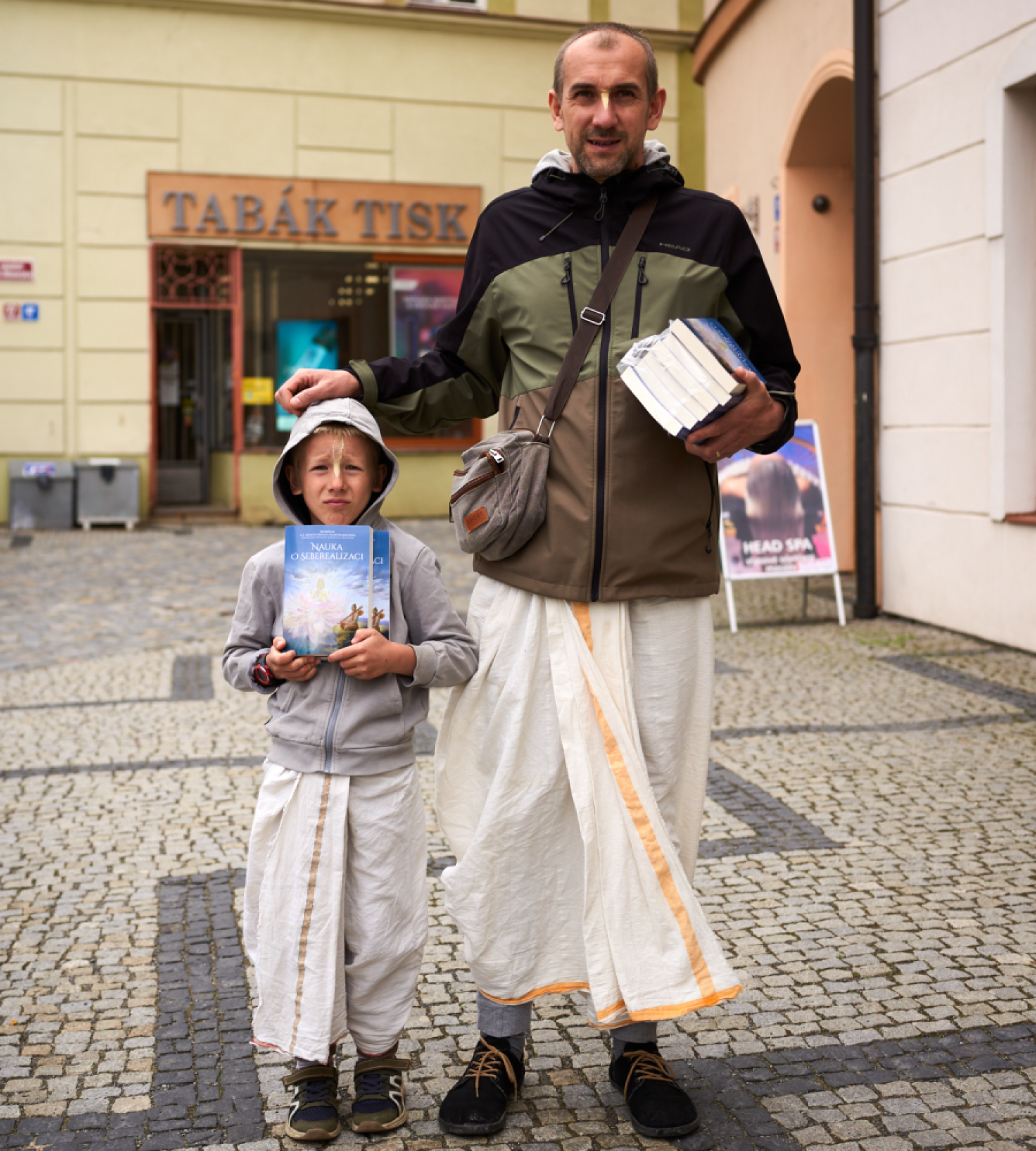
Serving in ISKCON for more than twenty-five years under a GBC leader who produced and inspired the distribution of more books in more languages in his zone than were distributed on the whole planet in Srila Prabhupada’s presence, I felt safe, and despite all the challenges, I felt supported in both capacities—as a sankirtan leader and as a temple president. It was customary in that part of the world that even when a sankirtan devotee reached his limit and, often for physical reasons, couldn’t continue this demanding service, he became a temple president, carrying the spirit of book distribution even into his managerial field.
Becoming a temple president for the first time, I kept a stock of books directly under my table, and if I felt the pressure of management becoming too demanding, I ran out onto the street, distributed a few books to the conditioned souls and returned enlivened to my office again. After all, Srila Prabhupada stated many times that his main objective in coming to the West was to publish and distribute books, as he was ordained by his spiritual master: “Whenever you get some money, print books.” Starting his preaching in the West with book distribution, bringing a few trunks of books from India, Srila Prabhupada later humbly stated that “if I would have just distributed these few books, at least something was done.”
It was for the sake of his books that he needed help, and so he started to initiate disciples. It was for the sake of his books that he opened temples, which he at first called “camps where our sankirtan soldiers can go out and fight with Maya.” It was these temples that he wished to be “filled up with so many books that there is no place for sleep for devotees. If they want to sleep, they must distribute some books.” It was here that he arranged for his Bhaktivedanta Book Trust also to serve the purpose of assisting temple foundations on the basis of his book distribution. More books being distributed means more centers being opened; that was his formula.
The spirit of book distribution, entirely foreign to me when I joined this movement in 1972, gave me new life. Actually, I was born again, as anything I had done before had nothing to do with it. Here, thrown into a state of total dependency on Srila Prabhupada and the Supreme Lord, I was facing severe opposition and insults at every step.
(As a Czechoslovakian immigrant in Germany, I got my dose of German-organized arrogance. Many still cried on Hitler’s birthday in 1972, mourning the lost war.)
Here I was, from one day to another, forced to reject all my material designations, my introverted artistic ideas; here I was forced to leave my old bodily identity behind.
Sankirtan book distribution doesn’t facilitate any falsity or pretence. Any other service can be pretended for a short while, but book distribution is only for the sincere and materially unmotivated. Even in those days, many of us joined and did this service because of social pressure—after all, if one didn’t distribute books, “one could go home again”—but only those who really understood how dear this book distribution was to Srila Prabhupada could sustain this service. Even though I met Srila Prabhupada only three times and never spoke to him, whenever I stood on the street, I felt him being very close, being in my heart.
It is service to the mission of the spiritual master that connects us to the guru and the guru-parampara, not religious rituals inspired by piety.
Book distribution, so said Srila Prabhupada, is a special service. As he wrote to me on 27th of October 1976:
“Krsna becomes more and more pleased by seeing the increment of book distribution. Devotional service is absolute but Krsna is especially pleased to see someone preaching His glories.”
Letter to Manidhara and Rohini Suta, India, 27th of October 1976
Obviously, even on the transcendental platform there is gradation, and sankirtan delivers the highest transcendental satisfaction. Why?
Because here one has to:
- Control one’s mind
- Control one’s senses
- Control one’s desires
- Control the modes of nature conditioning him
- Control one’s speech
- Control undesirable association
- Become tolerant, even of one’s own conditioning in terms of varna
- Become totally dependent on Krsna’s mercy, as the result is entirely up to Him
- Become firmly convinced about the exclusivity of devotional service
- Become truly compassionate, free of mundane sentimentality
- Become empowered to see what others cannot see
- Become immune to what was heard and will be heard on the mundane plane
- Become a speaker without many words, by delivering the book
- Become… a materially unmotivated servant of the Lord
These are only a few of the hundreds of attributes manifesting in the heart of a truly dedicated sankirtan devotee. As simple as the service is in itself, so demanding it is to our false ego, which is always ready to invent more and more intricacies, making us believe the unimportant to be important and the important to be unimportant. In this way our priorities shift, and we become a “false devotee,” a pretender.
When sankirtan book distribution is removed as the central focus of Srila Prabhupada’s movement and we become obsessed with all kinds of emotional, social and institutional issues, we enter a never-ending labyrinth of intricacies Maya is so expert at imposing upon us and… get lost.
This text is written by somebody who, also due to his varna conditioning, had his share of grhastha asrama, and even though it brought valuable experience to me, it finally only underlined the ultimate importance, the central meaning, of Srila Prabhupada’s books and their distribution. Whatever I managed as a temple president was more or less stolen or mismanaged by others. Whatever money I collected, if not spent on producing more books, was misused. But I have no regrets.
The books I distributed can never be collected or misused again. They are still out there, waiting to be rediscovered by the few sincere seekers who may read them and look for the movement Srila Prabhupada envisioned to be based on those books.
Regardless of one’s personal conditioning and disqualification, EVERYBODY can become part of book distribution, even a child. It doesn’t require any material qualification; it requires only sincerity and the desire to do it.
I was thrown into the streets without any prior training. Today we have FEW experienced book distributors who would be more than happy to help others become part of book distribution. Today most devotees are conditioned by going through the ordeals of grhastha asrama. But even there, one can be part of book distribution by supporting it financially or, even better, by supporting those very rare devotees who actually do it.
As long as book distribution remains in our focus, only auspiciousness arrives, regardless of how many read these books or how many actively join this movement. Srila Prabhupada, when arriving in America, couldn’t foresee how his books would be perceived by the public. On the order of his guru, he distributed them anyway.
It is book distribution that makes Srila Prabhupada’s movement distinct from all other spiritual movements. One can become, for a while, a false kirtaniya, using the Holy Name instead of serving it. Such sahajiya spirits are abundant amongst pseudo-devotees. One can become, if institutionally sheltered, financially secure and prominent in ISKCON. One can become famous on the basis of one’s mundane charisma; there are enough fools to be impressed.
But one cannot maintain these false identities by joining book distribution.
Book distribution reveals the Truth to us. This is why some are afraid of it. In no time, one’s misconceptions will be torn down and removed if one desires to maintain this service.
I was trained to meet my quota in terms of book distribution. Temples being constantly in debt put us under a regime of constant money-collecting marathons. When book distribution wasn’t profitable enough, we were induced to sell worthless paraphernalia. Thanks to congregational support, much of the pressure today is gone. Even though congregational support brings another sort of problem (no, the congregation is not “the temple owner” or the ultimate managerial authority; the temple president is!), it leaves the few remaining sankirtan devotees free to distribute Srila Prabhupada’s books at will, anytime, anywhere.
Did times change? Yes, to some degree they did, with the mass of conditioned souls still covered by luxury, which prevents them from seeing the need to cling to Krsna’s lotus feet. But that luxury is temporary, and as historically proven, time will destroy it all. Unfortunately, most conditioned souls accept Krsna’s mercy on the basis of pain, not on the basis of intelligence. Only by being pained may they finally open Srila Prabhupada’s books and read about reality and the need to surrender entirely to the Supreme Lord.
While some leaders of ISKCON are covered by the very same luxury conditioning, covered by the self-satisfied spirit of “I have done it; I don’t need to do it anymore,” inspiring their disciples, in exchange for good donations, to follow their sentimentality and not the order of the Founder-Acharya, and growing weaker and weaker while dying, the ones who cling to the original preaching spirit of Srila Prabhupada never give up their determination to be a real part of his real mission.
Times didn’t change in terms of the conditioning of the souls. It is the same eating-sleeping-sex-life Maya where, in their illusory ways, the conditioned souls still seek shelter at the mercy of fallible soldiers. Ignoring the presence of death, hoping against hope, they again and again hope to be able to maintain the status quo in terms of their sense enjoyment. Despite everybody dying, children are born; despite so much misery this world provides, the hope for a “happy life” never disappears.
It is here, in sankirtan book distribution, that the blessed devotee becomes an observer of this illusory display but never takes part in it. Even moving around with the same material body as others, he will get the blessings to understand that he is not this body, and putting the body to its best use, he is making “the best of a bad bargain.”
When times changed and ISKCON lost its book distribution focus, I was reminded of the time when, due to my physical situation after fifteen years of intense book distribution, I could no longer go out every day and face the conditioned souls’ obstinacy. It was at this time that a horrible thought appeared in my mind. I realised that most ISKCON leaders either abstained from the book distribution they had once been part of—the book distribution that brought them to Krsna Consciousness—or they had never done it. It is natural that non-book-distributing leaders will not be instrumental in creating another generation of book distributors.
Originally, I considered myself most offensive to these illustrious leaders, celebrated as pure devotees and initiating generations of pious non-sankirtan disciples, but over and over again, my doubts unfortunately got confirmed. “Whatever a great man is doing, the small man follows,” states Krsna in His Bhagavad-gita.
And so a kanistha-adhikari will attract kanistha-adhikaris, and a madhyama-adhikari will attract madhyama-adhikaris.
But there is hope. Speaking for Europe, the place I served in this lifetime, there are oases of the book distribution spirit, populated by amazing and rare book distributors who use every opportunity to introduce others to Srila Prabhupada’s books. It is these heroes who are able to change the karma of a whole nation, as one book of Srila Prabhupada can change the lives of so many.
And so, even one book being distributed is a great contribution to Srila Prabhupada’s Mission, the Mission of the Sankirtan Movement.
Or, as Srila Prabhupada says:
“My first concern is that my books shall be published and distributed profusely all over the world. Practically, books are the basis of our Movement. Without our books, our preaching will have no effect. So I am so much engladdened that you are enthusiastic to please me in this way, and that you are very determined to continue translating profusely. If you can increase translating more and more, that will advance you more and more in spiritual life. Krishna will give you all help.”